Skip to content
paysagement

How much does a paver pool deck cost in Quebec?

For a typical project of 41 m² (442 sq ft), unknown fill soil (all of Quebec): $23,989 doing it yourself, $20,000 to $33,000 by a contractor, before tax.

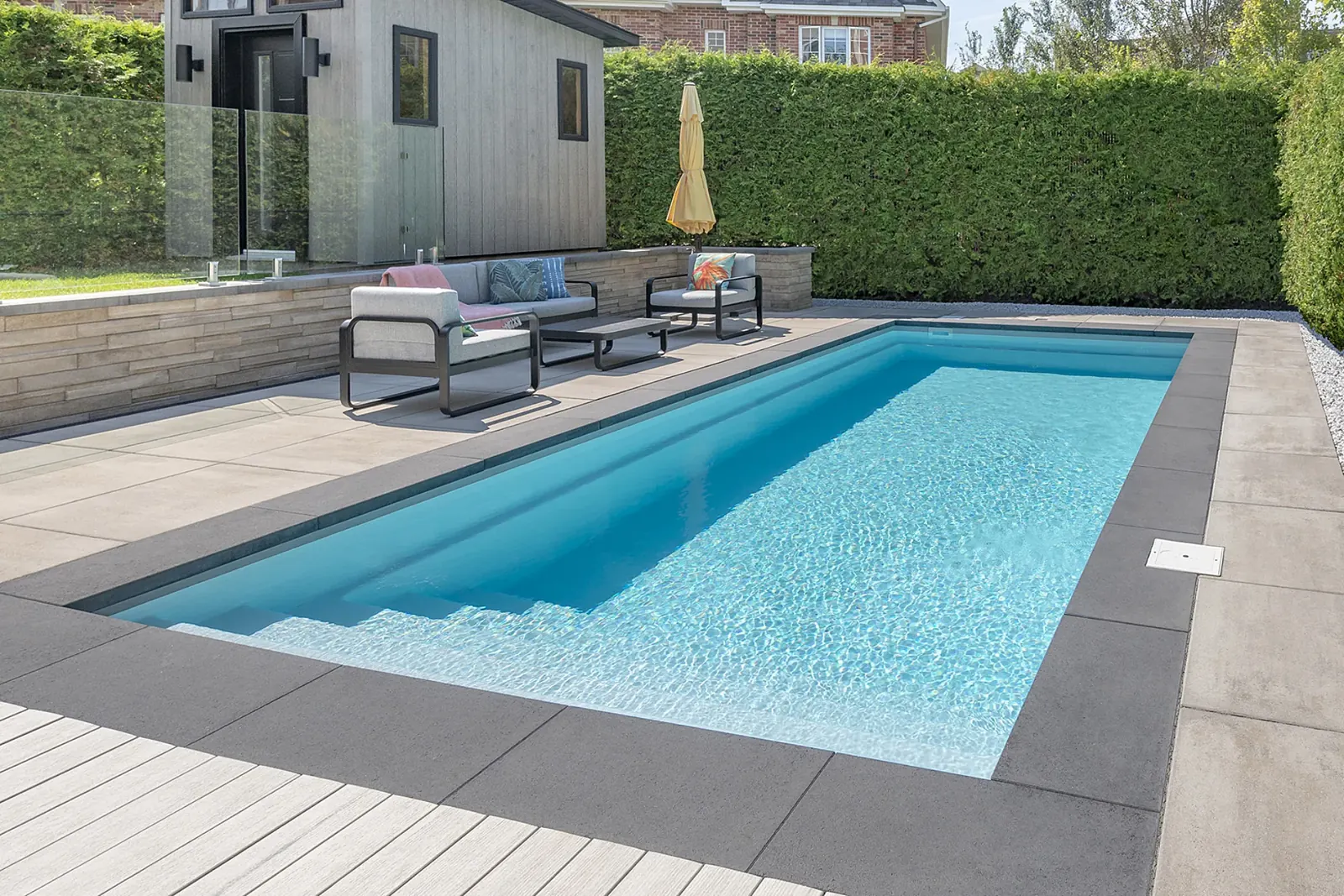
Proma XL caviar coping and slabs around a rectangular in-ground pool
Photo: Rinox

Prices follow the chosen region when it has observed prices; otherwise the province-wide value applies and the confidence grade drops.

Do it yourself or hire a contractor

Both columns come from the same engine, with the same quantities. The difference: labour, site-scale equipment, overhead and margin.

Do it yourself

Materials at retail prices, rentals, delivery and disposal, plus your time as a beginner (*).

$23,989

* Includes your time: 286.8 h × $35.05/h (beginner). Money spent only: $13,938

Before tax
Money spent only$13,938
GST (5%)$697
QST (9.975%)$1,390
Total with taxes$16,025

Tools to buy, on top: $305

By a contractor

Labour, equipment, materials, overhead and margin.

estimate
$20,000 to $33,000
Displayed range, before tax
That is $46 to $75 per sq ft, before tax
Typical scenario$26,106
GST (5%)$1,305
QST (9.975%)$2,604
Total with taxes$30,016

Crew pace: 93 person-hours

Stacked extremes (everything low, everything high): $12,687 to $55,387

The range shows the effect of documented price and productivity spreads. It is not a probability.
Hiring costs less if your time is worth more than:

estimate
$42/h
Based on beginner hours.

At $35/h: doing it yourself still costs less.

Break-even = (the contractor's typical price minus the money spent doing it yourself) divided by your person-hours. Before tax on both sides: GST and QST apply to both.

Your time

Your time
2
$35.05/h
By default, the average hourly wage in Quebec:
Money, hours, days, value of the time and true cost, beginner and intermediate
MeasureBeginnerIntermediate
Money spent$13,938$13,938
Person-hours287 h198 h
Days of 8 h, 2 people18 days12.5 days
Your time at $35/h$10,052$6,924
True cost$23,989$20,862

Working days only: add rain days and waiting times (curing, deliveries).

True cost: money and time

Before tax, one scale for every bar.

Money spentYour time ($35/h)Contractor's rangeTypical price ($26,000)
Do-it-yourself true cost and a contractor's price, before tax
Money, do it yourself$13,938
True cost, beginner$23,989
True cost, intermediate$20,862
Contractor$20,000 to $33,000 ($26,000)
Adjust the dimensions in the estimator

Where the money goes

A contractor's typical price, split by category. The same split applies to the do-it-yourself total, without overhead or margin.
Split of the typical price before tax
Materials29%$7,563
Labour13%$3,470
Equipment and rentals10%$2,726
Delivery and disposal10%$2,688
Overhead27%$7,049
Margin10%$2,611
What moves the total
  • Labour productivity (pavers): $22,783 to $30,191
  • Contractor overhead: $23,496 to $29,903
  • Price: Proma slab 60 mm: $23,665 to $28,548

The range shows the effect of documented price and productivity spreads. It is not a probability.

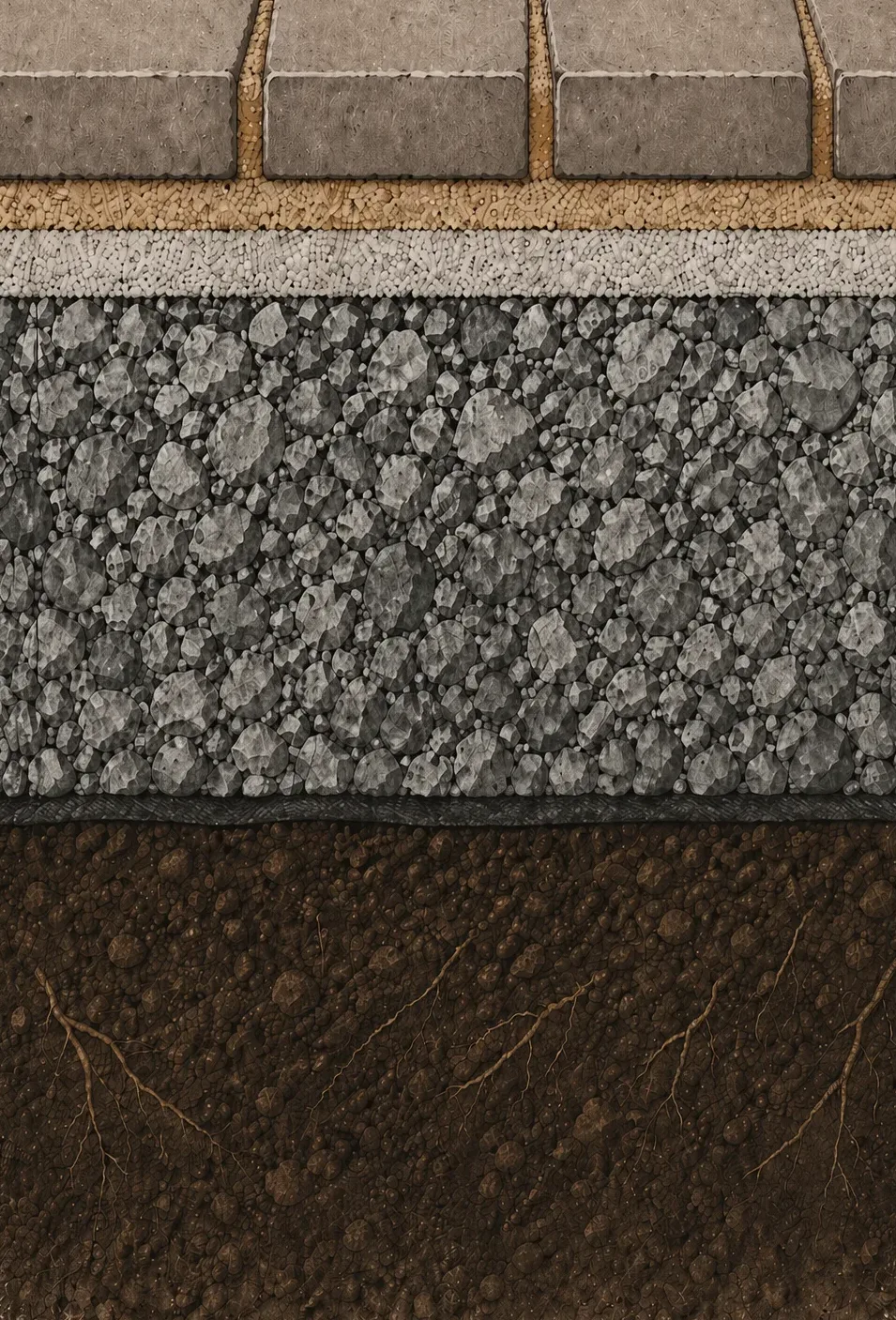
What is under a well-built patio

  1. 01Pavers or slabs

    60 mm (2.4 in)

    The only layer you see, and the quickest to lay when everything below it is right.

    If corners are cutMisaligned pavers and uneven joints. The cause is usually in the layers below.

    Why
  2. 02Polymeric sand

    joints

    Fills the joints, locks the pavers together, slows weeds and erosion.

    If corners are cutPlain sand: joints wash out, pavers move, weeds move in.

    Why
  3. 03Concrete sand bedding

    25 mm (1 in)

    A thin layer, screeded level, that gives the flat surface. It does not fix an uneven base.

    If corners are cutStone dust or too thick a bed: water stays trapped, the bed shifts and dips appear.

    Why
  4. 04MG-20 crushed stone base

    300 mm (11.8 in), in 3 lifts

    The heart of the job. It carries the loads, drains water and limits frost effects. It is spread and compacted in thin lifts.

    If corners are cutA base too thin or compacted in one go: settling and frost heave.

    Why
  5. 05Geotextile

    membrane

    On clay or silt, a fabric separates the stone from the fine soil so the two do not mix.

    If corners are cutWithout geotextile on fine soil, the base sinks into the soil within a few years and loses its bearing capacity.

    Why
  6. 06Native soil, excavated and compacted

    385 mm (15.2 in) in total

    The soil is dug to the computed depth, sloped and compacted. The base does not go below the frost line: it drains.

    If corners are cutDigging too shallow to save on the bin: the base is thin and the patio follows the soil's movements.

    Why

Thicknesses computed for: 41 m² (442 sq ft), unknown fill soil

Cross-section of a paver patio: pavers, polymeric sand joints, bedding, compacted crushed stone base, geotextile and native soil.

Difficulty, time and tools

Level

Pro recommended

Estimated working time
Beginner287 person-hours
Intermediate198 person-hours

Hours for the typical project: the work calculation (a crew's pace times the level's factor, with rework, learning and unloading) plus the guide's planning and checks.

To rent
  • Mini excavator 3.5 t
  • Skid steer
  • Plate compactor
  • 14 in cut-off saw
To buy
  • Marking paint
  • Heavy tarp
  • Stakes and mason's string
  • 3 m aluminium straightedge
  • 3 lb sledgehammer
  • Work gloves
  • Two 1 in pipes (screed rails)
  • Rubber mallet
  • Knee pads
  • Diamond blade for concrete
  • Safety glasses, hearing protection and a well-fitted dust mask
When to call a pro
  • Any digging needs an Info-Excavation locate request at least 4 business days before starting, and hand digging within 1 m of the marks.Applies to the typical project
  • A surround that touches the enclosure, its gates or access to the pool needs a municipal permit, and the holder must control access during the work.Applies to the typical project
  • Moving or changing lighting, a receptacle, the bonding or the pump's power supply is electrical work: hire a master electrician who is a CMEQ member. An owner may not do it themselves.Applies to the typical project
  • Before touching the coping or the backfill against the wall, get the pool maker's deck detail or hire a pool installer.Applies to the typical project
  • Paving over an existing slab needs a sound slab and drainage holes drilled through it. Have a professional assess the slab before choosing this method.
  • A surface higher than the existing ground needs fill compacted in lifts and often a low wall or retaining wall. A wall that holds back soil can fall under the Engineers Act depending on its function, the soil and the loads: see the walls guide and a professional.
See in the guide

The five phases

Every project follows the same sequence. The guide details each step, with its times and quantities.
  1. 01

    Assess the pool and its surround

    A pool surround is a patio at the water's edge: splashing, bare feet, treated water. Three existing elements drive the work: the pool itself, with its wall, coping and lines; the enclosure that controls access; and the equipment with its power supply. The soil around an in-ground pool is often disturbed backfill, hence the cautious assumption in "Your project".

  2. 02

    Permit, enclosure and locates

    In Quebec, a municipal permit is required to build anything that gives or blocks access to a pool, and the permit holder must control access during the work. Around a pool, most pipes and cables are private: Info-Excavation does not locate them.

  3. 03

    Layout and excavation

    Grades start from the coping: the finished surface meets it at the height given by the pool maker's detail, then falls away. Along the wall, dig by hand and without a machine: the soil against the wall is part of what supports the pool.

  4. 04

    Base

    A surround's base follows the patio row of the table, with careful drainage. The backfill around an in-ground pool often settles over the years: compact it carefully in thin lifts, and stay cautious against the wall.

  5. 05

    Laying and finishing

    Laying starts at the coping and moves outward. The pool's curves need many cuts, and the pool water must stay protected from dust, cutting slurry and sand. Nothing reopens before the enclosure check.

Rules in Quebec

What the law and municipalities require for this kind of work. Each line cites its source.
  • SafetyAll of Quebec

    The residential pool safety regulation requires an enclosure around every pool whose water is 60 cm deep or more. The enclosure is at least 1.2 m high, stops a 10 cm sphere, offers no hold for climbing (chain-link mesh openings of at most 30 mm), and a hedge does not count. Every gate closes and latches automatically, with the latch on the inside at the top of the gate or on the outside at least 1.5 m above ground. Municipalities may be stricter.

    Gouvernement du Québec (LégisQuébec)Gouvernement du Québec (LégisQuébec)Gouvernement du Québec (LégisQuébec)Gouvernement du QuébecChecked October 10, 2026

  • PermitAll of Quebec

    A municipal permit is required to build, install or replace a pool or to build anything that gives or blocks access to a pool. During the work, the permit holder must take temporary measures to control access.

    Gouvernement du Québec (LégisQuébec)Checked October 10, 2026

  • SafetyAll of Quebec

    Pool equipment (pump, filter, heater) is installed more than 1 m from the pool wall or enclosure, except as the regulation provides, and any fixed structure or equipment that could be used to climb is kept at least 1 m away.

    Gouvernement du Québec (LégisQuébec)Checked October 10, 2026

  • SafetyAll of Quebec

    Installations existing before 1 November 2010 must comply by 30 September 2027; replacing the pool triggers full compliance. An owner in breach faces a fine of $500 to $700, $700 to $1,000 for a repeat offence. Montreal and Quebec City both remind owners of this deadline.

    Gouvernement du Québec (LégisQuébec)Ville de MontréalVille de QuébecChecked October 10, 2026

  • LicenceAll of Quebec

    Pool electrical work (pump, lighting, receptacles, bonding) is reserved to master electricians who are CMEQ members when done for others, and an owner may not do it themselves. The paving itself needs no licence on private land.

    Gouvernement du Québec (LégisQuébec)Régie du bâtiment du QuébecChecked October 10, 2026

  • LocateAll of Quebec

    Before digging, file a free request with Info-Excavation. The RBQ asks contractors to file it at least 4 business days before the work; it is valid until the stated end date, for at most 180 days. The construction safety code requires the employer to locate lines before digging. For an owner doing their own work, the request is strongly recommended even though that duty targets employers, and some municipalities, such as Magog, require it on their land.

    Régie du bâtiment du QuébecGouvernement du Québec (LégisQuébec)Ville de MagogChecked October 10, 2026

  • LicenceAll of Quebec

    Per the RBQ licence guide, landscaping on private land, such as private driveways, low walls and paver landings resting on gravel that are not attached to the building, needs no licence. Owners may do this work at their own home, except electrical and gas work, which always goes to a qualified contractor. If you hire, check in the RBQ register that the contractor's subcategories cover the other parts of the contract, such as excavation or concrete.

    Régie du bâtiment du QuébecRégie du bâtiment du QuébecRégie du bâtiment du QuébecChecked October 10, 2026

  • NeighboursAll of Quebec

    The Civil Code (art. 979) requires lower land to receive the natural flow from higher land, but forbids the owner of the higher land from making the neighbour's situation worse. A new paved surface that concentrates water toward the lot line can therefore make you liable.

    Gouvernement du QuébecChecked October 10, 2026

Before you hire

Six questions to ask every contractor. A good quote answers them in writing, with numbers.
  1. 01

    How thick is the base, and what material?

    The answer should be a number in millimetres and a named material, for example MG-20, matched to the soil and the use.

  2. 02

    In how many lifts is the base compacted?

    A base is compacted in thin lifts with a plate compactor. One pass over the full thickness is not enough.

  3. 03

    Is a geotextile included?

    On clay or silt, it separates the stone from the fine soil. Without it, the base mixes into the soil over the years.

  4. 04

    Which bedding and which joint sand?

    Concrete sand for the bedding, polymeric sand for the joints. Stone dust holds water under the pavers.

  5. 05

    Which edge restraint, and on which sides?

    Every free side needs an edge restraint fixed into the base, or the pavers spread apart.

  6. 06

    What labour warranty, in writing?

    The number of years and what is covered: settling, heaving, joints.

In every case: an RBQ licence when the work requires one, a business number (NEQ), civil liability insurance and a written contract.

Guide: choosing a contractor

Sources and review

Draft: this content has not yet been reviewed by an installer or an engineer. The numbers come from the engine; the explanations may still change.

  • Last reviewed: October 10, 2026
  • Next review due: April 10, 2027
  • 40 sources cited
All the guide's sources

Words used on this page