Skip to content
paysagement

How much does yard grading cost in Quebec?

For a typical project of 100 m² (1,076 sq ft) of reshaped ground (all of Quebec): $2,798 doing it yourself, $2,000 to $2,900 by a contractor, before tax.

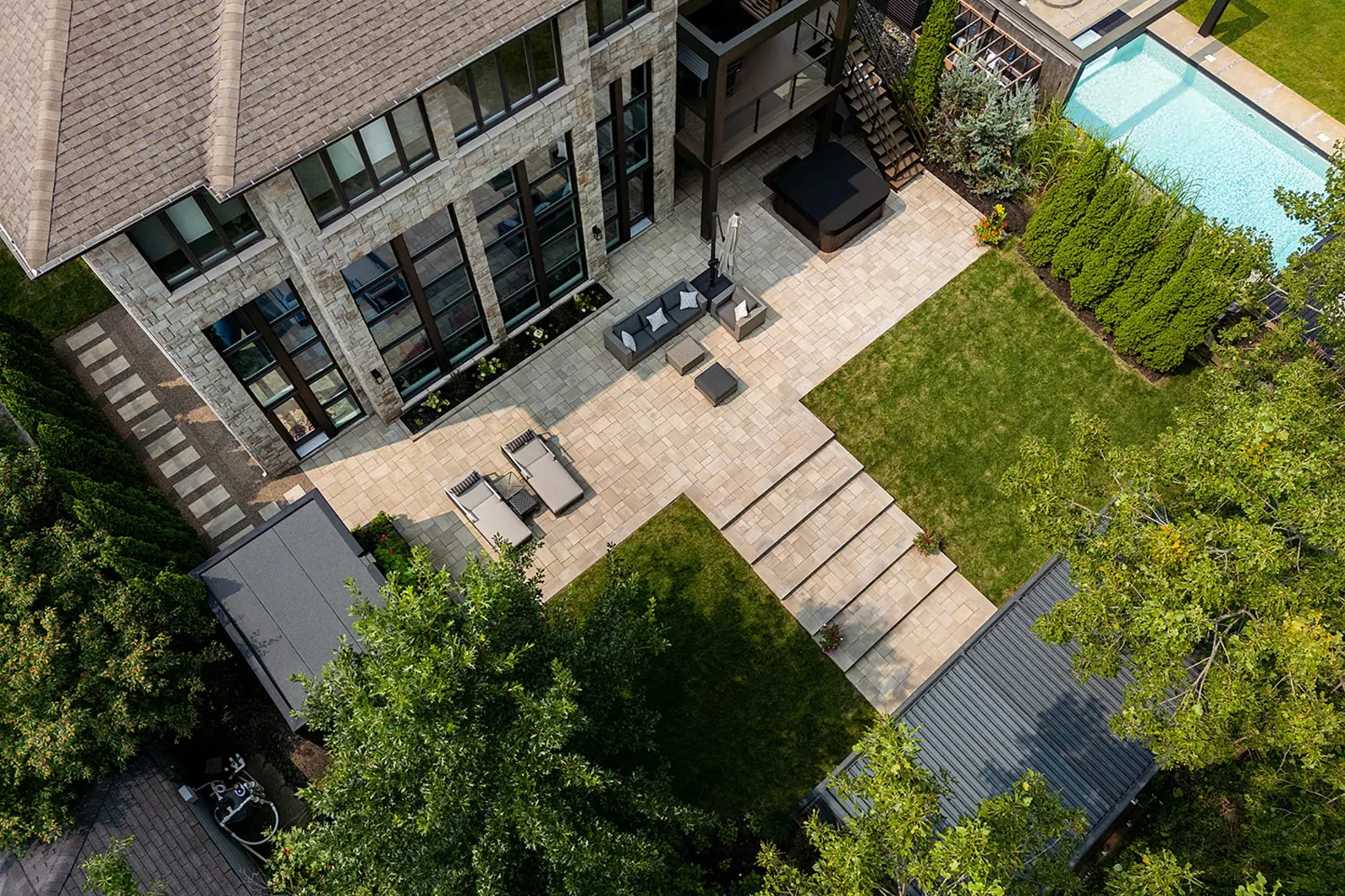
Sloped backyard built in terraces with patios, walls and lawn, aerial view
Photo: Rinox

Prices follow the chosen region when it has observed prices; otherwise the province-wide value applies and the confidence grade drops.

Do it yourself or hire a contractor

Both columns come from the same engine, with the same quantities. The difference: labour, site-scale equipment, overhead and margin.

Do it yourself

Materials at retail prices, rentals, delivery and disposal, plus your time as a beginner (*).

$2,798

* Includes your time: 45.5 h × $35.05/h (beginner). Money spent only: $1,201

Before tax
Money spent only$1,201
GST (5%)$60
QST (9.975%)$120
Total with taxes$1,381

Tools to buy, on top: $180

By a contractor

Labour, equipment, materials, overhead and margin.

estimate
$2,000 to $2,900
Displayed range, before tax
Typical scenario$2,362
GST (5%)$118
QST (9.975%)$236
Total with taxes$2,716

Crew pace: 12 person-hours

Stacked extremes (everything low, everything high): $1,484 to $4,172

The range shows the effect of documented price and productivity spreads. It is not a probability.
Hiring costs less if your time is worth more than:

estimate
$25/h
Based on beginner hours.

At $35/h: hiring costs less.

Break-even = (the contractor's typical price minus the money spent doing it yourself) divided by your person-hours. Before tax on both sides: GST and QST apply to both.

Your time

Your time
2
$35.05/h
By default, the average hourly wage in Quebec:
Money, hours, days, value of the time and true cost, beginner and intermediate
MeasureBeginnerIntermediate
Money spent$1,201$1,201
Person-hours46 h31 h
Days of 8 h, 2 people3 days2 days
Your time at $35/h$1,596$1,085
True cost$2,798$2,287

Working days only: add rain days and waiting times (curing, deliveries).

True cost: money and time

Before tax, one scale for every bar.

Money spentYour time ($35/h)Contractor's rangeTypical price ($2,400)
Do-it-yourself true cost and a contractor's price, before tax
Money, do it yourself$1,201
True cost, beginner$2,798
True cost, intermediate$2,287
Contractor$2,000 to $2,900 ($2,400)
Adjust the dimensions in the estimator

Where the money goes

A contractor's typical price, split by category. The same split applies to the do-it-yourself total, without overhead or margin.
Split of the typical price before tax
Materials1%$19
Labour23%$553
Equipment and rentals34%$792
Delivery and disposal5%$125
Overhead27%$638
Margin10%$236
What moves the total
  • Contractor overhead: $2,126 to $2,706
  • Contractor profit: $2,126 to $2,566
  • Labour productivity (grading): $2,212 to $2,593

The range shows the effect of documented price and productivity spreads. It is not a probability.

Difficulty, time and tools

Level

Intermediate

Estimated working time
Beginner46 person-hours
Intermediate31 person-hours

Hours for the typical project: the work calculation (a crew's pace times the level's factor, with rework, learning and unloading) plus the guide's planning and checks.

To rent
  • Rotating laser
  • Skid steer
  • Medium reversible plate
To buy
  • String, stakes and line level
  • Tarp
  • Landscape rake
When to call a pro
  • All grading disturbs the ground: file a free Info-Excavation request before you start, and keep machines 1 m from the marks.Applies to the typical project
  • You are changing the grade near the property line: have a land surveyor confirm the line and make sure you do not worsen the flow onto the neighbour (Civil Code, art. 979).
  • A slope over 33% will not hold without a wall or stabilization. Have a stabilized bank or wall designed; depending on the soil and what it holds back, an engineer may be required whatever the height.
  • The lot is in a landslide-prone zone: do not fill or cut a bank without a geotechnical engineer's advice and the municipality's approval.
  • Work near a watercourse or shoreline: special rules often apply. Get the municipality's approval before moving soil.
  • You are adding fill: some cities regulate bringing in soil and changing ground levels. Check with your municipality before ordering.Applies to the typical project

The five phases

Every project follows the same sequence. The guide details each step, with its times and quantities.
  1. 01

    Understand where water goes today

    The goal is positive drainage: the ground falls away from the foundation on every side, then the water keeps going to a place that can take it (lawn, planting bed, swale, street) without crossing the neighbour's lot.

  2. 02

    Locates, permits and neighbours

    Info-Excavation is free. The RBQ asks contractors to file at least 4 business days before digging; Hydro-Québec advises homeowners to allow 72 hours, or 3 business days when a pipeline is involved. Even shallow grading disturbs the ground: file the request.

  3. 03

    Strip and cut the high spots

    Keep the topsoil apart from the start: it will become the finished surface again. Then lower the high spots and move the soil to the hollows marked on the sketch.

  4. 04

    Fill in layers and compact

    Fill goes down in thin layers, each one compacted before the next; the engine uses layers of 200 mm at most. One thick layer settles for months and makes a new hollow that sends water back toward the house.

  5. 05

    Finish, downspouts and protecting the soil

    Shape the surface, put the topsoil back, then cover it quickly with sod, seed or mulch: bare soil erodes in the first heavy rain (see the sod guide).

Rules in Quebec

What the law and municipalities require for this kind of work. Each line cites its source.

Before you hire

Six questions to ask every contractor. A good quote answers them in writing, with numbers.
  1. 01

    Who files the Info-Excavation request, and when?

    Locating underground networks is free and requested before digging. The requester's name and the ticket number should be on file.

  2. 02

    Where does the water go once the work is done?

    The slope, the outlet and what happens at the property line. You may not make runoff onto the neighbour worse.

  3. 03

    How much soil leaves the site, and where does it go?

    The quantity in cubic metres or tonnes, and whether hauling and disposal are in the price.

  4. 04

    Which materials and which thicknesses?

    Clear stone, topsoil, fill: the material's name and the thickness in millimetres.

  5. 05

    What gets restored?

    Lawn, driveway, beds damaged by machinery: included or not.

  6. 06

    What warranty, in writing?

    For sod take, the drain working, or fill settling.

In every case: an RBQ licence when the work requires one, a business number (NEQ), civil liability insurance and a written contract.

Guide: choosing a contractor

Sources and review

Draft: this content has not yet been reviewed by an installer or an engineer. The numbers come from the engine; the explanations may still change.

  • Last reviewed: October 10, 2026
  • Next review due: October 10, 2027
  • 21 sources cited
All the guide's sources

Words used on this page