Skip to content
paysagement

How much does a paver patio cost in Quebec?

For a typical project of 27.9 m² (300 sq ft), sand and gravel soil (all of Quebec): $12,616 doing it yourself, $11,000 to $18,000 by a contractor, before tax.

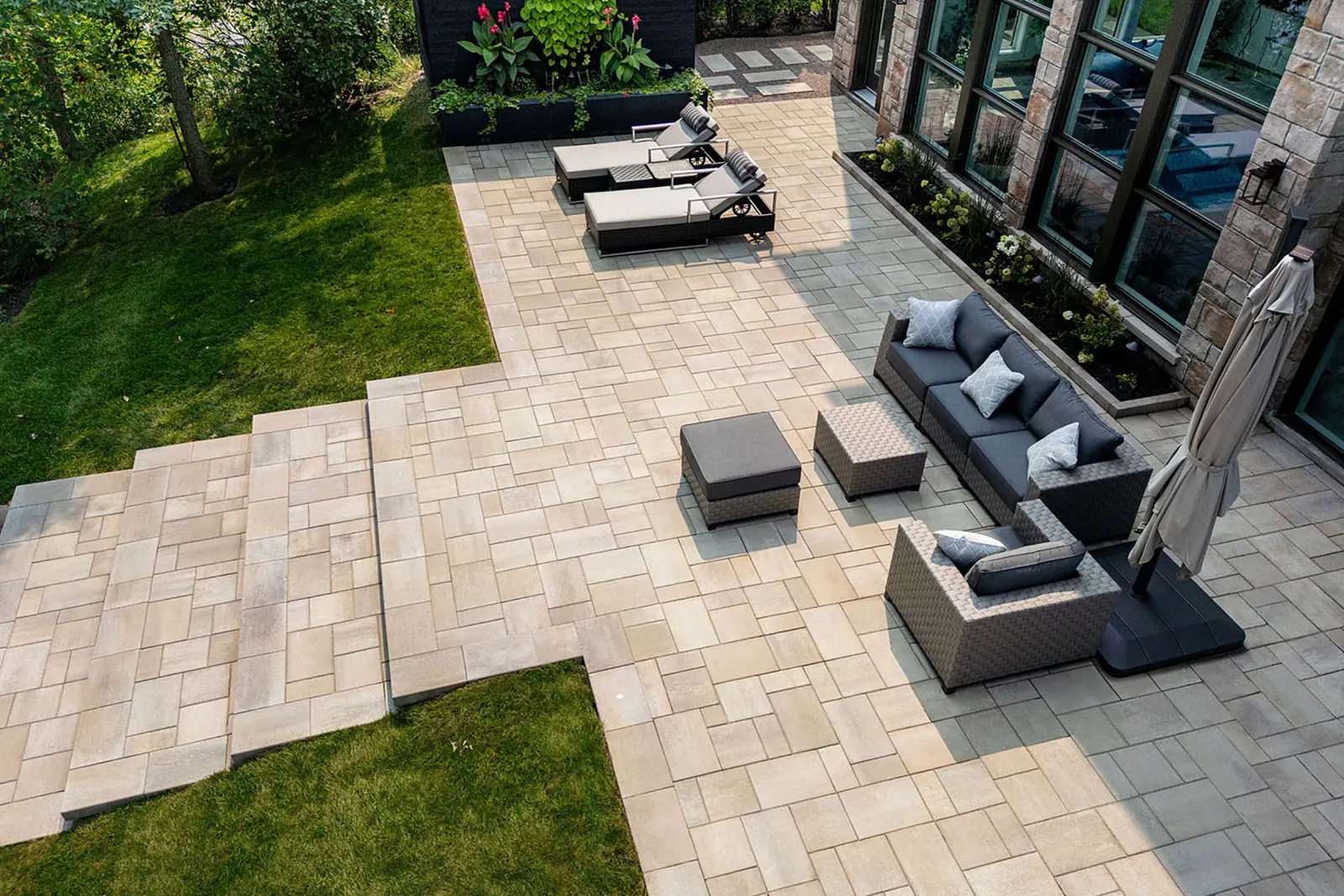
Aspen FLEX slab patio in Oka beige with outdoor lounge furniture, seen from above
Photo: Rinox

Prices follow the chosen region when it has observed prices; otherwise the province-wide value applies and the confidence grade drops.

Do it yourself or hire a contractor

Both columns come from the same engine, with the same quantities. The difference: labour, site-scale equipment, overhead and margin.

Do it yourself

Materials at retail prices, rentals, delivery and disposal, plus your time as a beginner (*).

$12,616

* Includes your time: 152 h × $35.05/h (beginner). Money spent only: $7,290

Before tax
Money spent only$7,290
GST (5%)$364
QST (9.975%)$727
Total with taxes$8,381

Tools to buy, on top: $305

By a contractor

Labour, equipment, materials, overhead and margin.

estimate
$11,000 to $18,000
Displayed range, before tax
That is $37 to $59 per sq ft, before tax
Typical scenario$14,251
GST (5%)$713
QST (9.975%)$1,422
Total with taxes$16,385

Crew pace: 50 person-hours

Stacked extremes (everything low, everything high): $7,079 to $27,698

The range shows the effect of documented price and productivity spreads. It is not a probability.
Hiring costs less if your time is worth more than:

estimate
$46/h
Based on beginner hours.

At $35/h: doing it yourself still costs less.

Break-even = (the contractor's typical price minus the money spent doing it yourself) divided by your person-hours. Before tax on both sides: GST and QST apply to both.

Your time

Your time
2
$35.05/h
By default, the average hourly wage in Quebec:
Money, hours, days, value of the time and true cost, beginner and intermediate
MeasureBeginnerIntermediate
Money spent$7,290$7,290
Person-hours152 h105 h
Days of 8 h, 2 people9.5 days7 days
Your time at $35/h$5,326$3,671
True cost$12,616$10,961

Working days only: add rain days and waiting times (curing, deliveries).

True cost: money and time

Before tax, one scale for every bar.

Money spentYour time ($35/h)Contractor's rangeTypical price ($14,000)
Do-it-yourself true cost and a contractor's price, before tax
Money, do it yourself$7,290
True cost, beginner$12,616
True cost, intermediate$10,961
Contractor$11,000 to $18,000 ($14,000)
Adjust the dimensions in the estimator

Where the money goes

A contractor's typical price, split by category. The same split applies to the do-it-yourself total, without overhead or margin.
Split of the typical price before tax
Materials29%$4,080
Labour13%$1,907
Equipment and rentals11%$1,554
Delivery and disposal10%$1,438
Overhead27%$3,848
Margin10%$1,425
What moves the total
  • Contractor overhead: $12,826 to $16,324
  • Labour productivity (pavers): $12,681 to $15,926
  • Price: Proma slab 60 mm: $12,749 to $15,754

The range shows the effect of documented price and productivity spreads. It is not a probability.

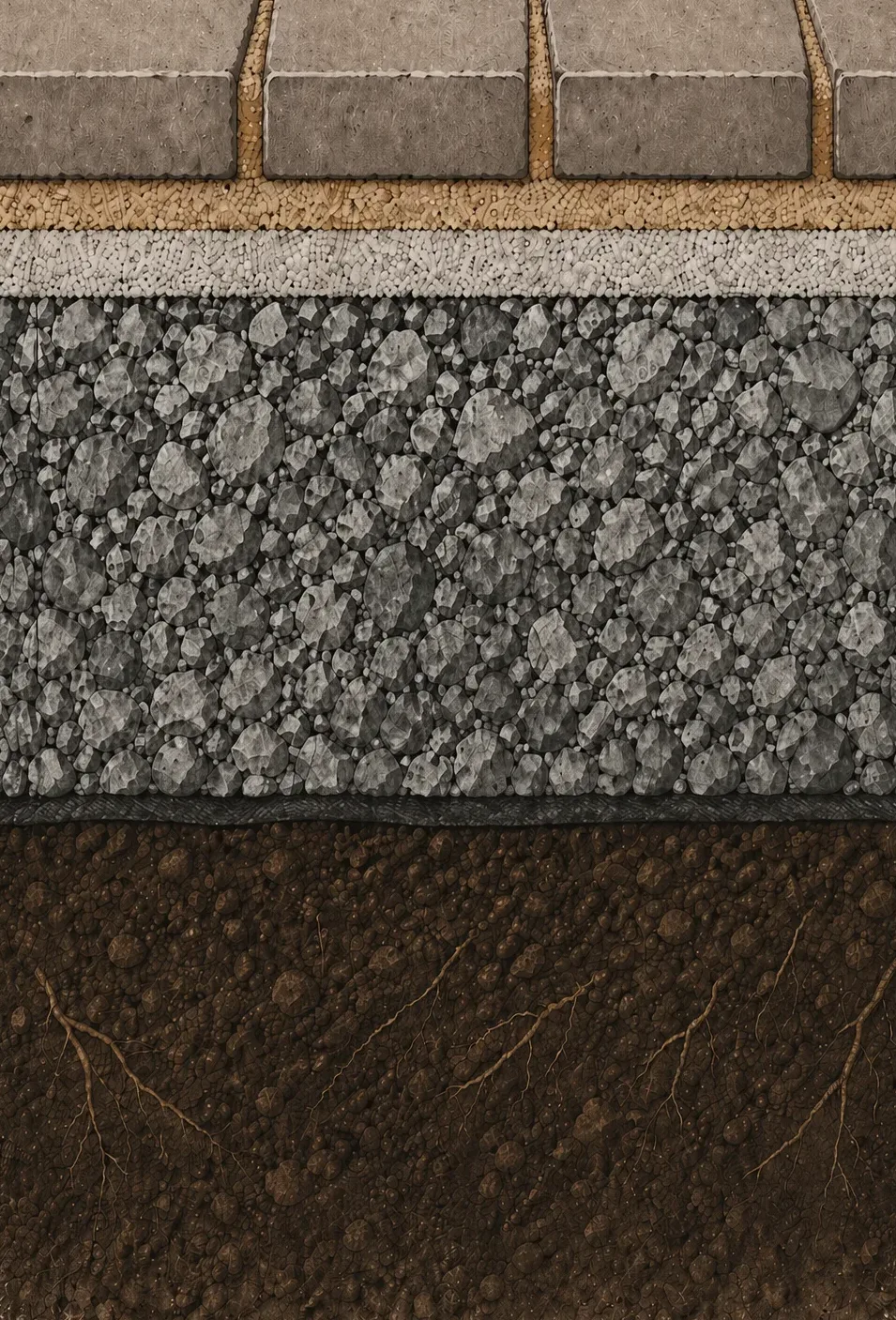
What is under a well-built patio

  1. 01Pavers or slabs

    60 mm (2.4 in)

    The only layer you see, and the quickest to lay when everything below it is right.

    If corners are cutMisaligned pavers and uneven joints. The cause is usually in the layers below.

    Why
  2. 02Polymeric sand

    joints

    Fills the joints, locks the pavers together, slows weeds and erosion.

    If corners are cutPlain sand: joints wash out, pavers move, weeds move in.

    Why
  3. 03Concrete sand bedding

    25 mm (1 in)

    A thin layer, screeded level, that gives the flat surface. It does not fix an uneven base.

    If corners are cutStone dust or too thick a bed: water stays trapped, the bed shifts and dips appear.

    Why
  4. 04MG-20 crushed stone base

    200 mm (7.9 in), in 2 lifts

    The heart of the job. It carries the loads, drains water and limits frost effects. It is spread and compacted in thin lifts.

    If corners are cutA base too thin or compacted in one go: settling and frost heave.

    Why
  5. 05Geotextile

    membrane

    On clay or silt, a fabric separates the stone from the fine soil so the two do not mix.

    If corners are cutWithout geotextile on fine soil, the base sinks into the soil within a few years and loses its bearing capacity.

    Why
  6. 06Native soil, excavated and compacted

    285 mm (11.2 in) in total

    The soil is dug to the computed depth, sloped and compacted. The base does not go below the frost line: it drains.

    If corners are cutDigging too shallow to save on the bin: the base is thin and the patio follows the soil's movements.

    Why

Thicknesses computed for: 27.9 m² (300 sq ft), sand and gravel soil

Cross-section of a paver patio: pavers, polymeric sand joints, bedding, compacted crushed stone base, geotextile and native soil.

Difficulty, time and tools

Level

Intermediate

Estimated working time
Beginner152 person-hours
Intermediate105 person-hours

Hours for the typical project: the work calculation (a crew's pace times the level's factor, with rework, learning and unloading) plus the guide's planning and checks.

To rent
  • Mini excavator 1.7 t
  • Plate compactor
  • 14 in cut-off saw
To buy
  • Marking paint
  • Heavy tarp
  • Stakes and mason's string
  • 3 m aluminium straightedge
  • 3 lb sledgehammer
  • Work gloves
  • Two 1 in pipes (screed rails)
  • Rubber mallet
  • Knee pads
  • Diamond blade for concrete
  • Safety glasses, hearing protection and a well-fitted dust mask
When to call a pro
  • Any digging needs an Info-Excavation locate request at least 4 business days before starting, and hand digging within 1 m of the marks.Applies to the typical project
  • A surface for heavy vehicles (RV, delivery trucks, commercial use) needs a design by an engineer or a geotechnical specialist; this guide does not cover it.
  • Paving over a roof, deck or garage adds load to the structure and affects the waterproofing: hire a structural engineer.
  • Paving over an existing slab needs a sound slab and drainage holes drilled through it. Have a professional assess the slab before choosing this method.
  • Permeable paving on silt, clay or unknown soil stores water in the base. If it does not drain before freeze-up, it lifts the paving: have the system designed by a professional.
  • Below a 1.5% slope, water is likely to pond on the pavers. Have a professional check the drainage, or increase the slope.
See in the guide

The five phases

Every project follows the same sequence. The guide details each step, with its times and quantities.
  1. 01

    Assess your patio

    A paver patio is a flexible system that floats on a stone base. It does not go below the frost depth: it gets through winter thanks to a thick, free-draining base, a slope that sheds water and joints that let the pavers move a little. The two decisions that matter most are made before digging: the type of soil and where the water goes.

  2. 02

    Locates, rules and orders

    Municipal rules vary from city to city and, in Montreal, from borough to borough, especially in front yards. Locating underground networks is free and comes before any digging.

  3. 03

    Layout and excavation

    The excavation depth adds up three layers: the paver, the bedding and the base, whose thickness comes from the maker's table by use and soil. "Your project" shows the depth and the volume of soil to haul away for your dimensions.

  4. 04

    Base

    The base carries the loads, drains water and limits the effect of frost. On clay or silt it is markedly thicker than on sand or gravel, and a geotextile separates it from the soil. It also extends past the pavers on free sides to carry the edging.

  5. 05

    Laying and finishing

    Laying goes fast when the base is right. The sand bed stays thin and even, the pavers are tight, the edges are cut cleanly, and everything is compacted before and after jointing. Polymeric sand needs a dry day.

Rules in Quebec

What the law and municipalities require for this kind of work. Each line cites its source.
  • LocateAll of Quebec

    Before digging, file a free request with Info-Excavation. The RBQ asks contractors to file it at least 4 business days before the work; it is valid until the stated end date, for at most 180 days. The construction safety code requires the employer to locate lines before digging. For an owner doing their own work, the request is strongly recommended even though that duty targets employers, and some municipalities, such as Magog, require it on their land.

    Régie du bâtiment du QuébecGouvernement du Québec (LégisQuébec)Ville de MagogChecked October 10, 2026

  • LicenceAll of Quebec

    Per the RBQ licence guide, landscaping on private land, such as private driveways, low walls and paver landings resting on gravel that are not attached to the building, needs no licence. Owners may do this work at their own home, except electrical and gas work, which always goes to a qualified contractor. If you hire, check in the RBQ register that the contractor's subcategories cover the other parts of the contract, such as excavation or concrete.

    Régie du bâtiment du QuébecRégie du bâtiment du QuébecRégie du bâtiment du QuébecChecked October 10, 2026

  • PermitMontréal

    In Montreal, a permit is needed to build, modify or remove a parking space or access, and front-yard rules vary by borough: Saint-Laurent caps paving at 40% of the front yard with a 1 m green strip along the lot line, and several boroughs require materials with a solar reflectance index of at least 29. For a back-yard patio, check your borough's zoning bylaw.

    Ville de MontréalChecked October 10, 2026

  • NeighboursAll of Quebec

    The Civil Code (art. 979) requires lower land to receive the natural flow from higher land, but forbids the owner of the higher land from making the neighbour's situation worse. A new paved surface that concentrates water toward the lot line can therefore make you liable.

    Gouvernement du QuébecChecked October 10, 2026

  • Consumer protectionAll of Quebec

    If you hire, ask for a written contract. The RBQ recommends that it show the licence number where applicable, the NEQ, the GST and QST numbers, the exact legal name and an itemized price (labour, materials, transport, equipment rental, subcontractors), with the smallest possible deposit. The Office de la protection du consommateur also lists what to ask for.

    Régie du bâtiment du QuébecOffice de la protection du consommateurChecked October 10, 2026

Before you hire

Six questions to ask every contractor. A good quote answers them in writing, with numbers.
  1. 01

    How thick is the base, and what material?

    The answer should be a number in millimetres and a named material, for example MG-20, matched to the soil and the use.

  2. 02

    In how many lifts is the base compacted?

    A base is compacted in thin lifts with a plate compactor. One pass over the full thickness is not enough.

  3. 03

    Is a geotextile included?

    On clay or silt, it separates the stone from the fine soil. Without it, the base mixes into the soil over the years.

  4. 04

    Which bedding and which joint sand?

    Concrete sand for the bedding, polymeric sand for the joints. Stone dust holds water under the pavers.

  5. 05

    Which edge restraint, and on which sides?

    Every free side needs an edge restraint fixed into the base, or the pavers spread apart.

  6. 06

    What labour warranty, in writing?

    The number of years and what is covered: settling, heaving, joints.

In every case: an RBQ licence when the work requires one, a business number (NEQ), civil liability insurance and a written contract.

Guide: choosing a contractor

Sources and review

Draft: this content has not yet been reviewed by an installer or an engineer. The numbers come from the engine; the explanations may still change.

  • Last reviewed: October 10, 2026
  • Next review due: April 10, 2027
  • 39 sources cited
All the guide's sources

Words used on this page